The Sales Appointment
Six steps, ninety minutes, one consultant. The Greeting and Financial Discussion scripts are in here word for word, on a clock, so no step gets skipped and the numbers land in the same order every time.
Welcome · Discovery · Orientate · Present Solution · Tour · Summarise. Taken from the scripts, not invented.
Spoken lines sit in white cards with a tan rule. Grey bracketed lines are things you do, not say.
Prices and the recurrent fee are typed in on the day, one field per layout, and carry through to the summary.
You'll say this list out loud in Step 01. People relax when they know the shape of the hour and a half.
“Hi {{ firstNames }}, thanks so much for taking the time to visit Oak Tree Taylor Street today. It's great to have you here.”
“If it's okay with you, what I'd love to do over the next hour and a half or so is, firstly, get to know a little more about you, what's brought you here today, what matters most to you in a move like this, and what kind of home you're picturing, whether that's a two-bedroom or a three-bedroom villa. We'll also touch on your budget and whether you've visited any other villages already.”
“Then give you a quick overview of Oak Tree and Aware Super, and the work we do across our villages in New South Wales, Queensland, Victoria and Tasmania.”
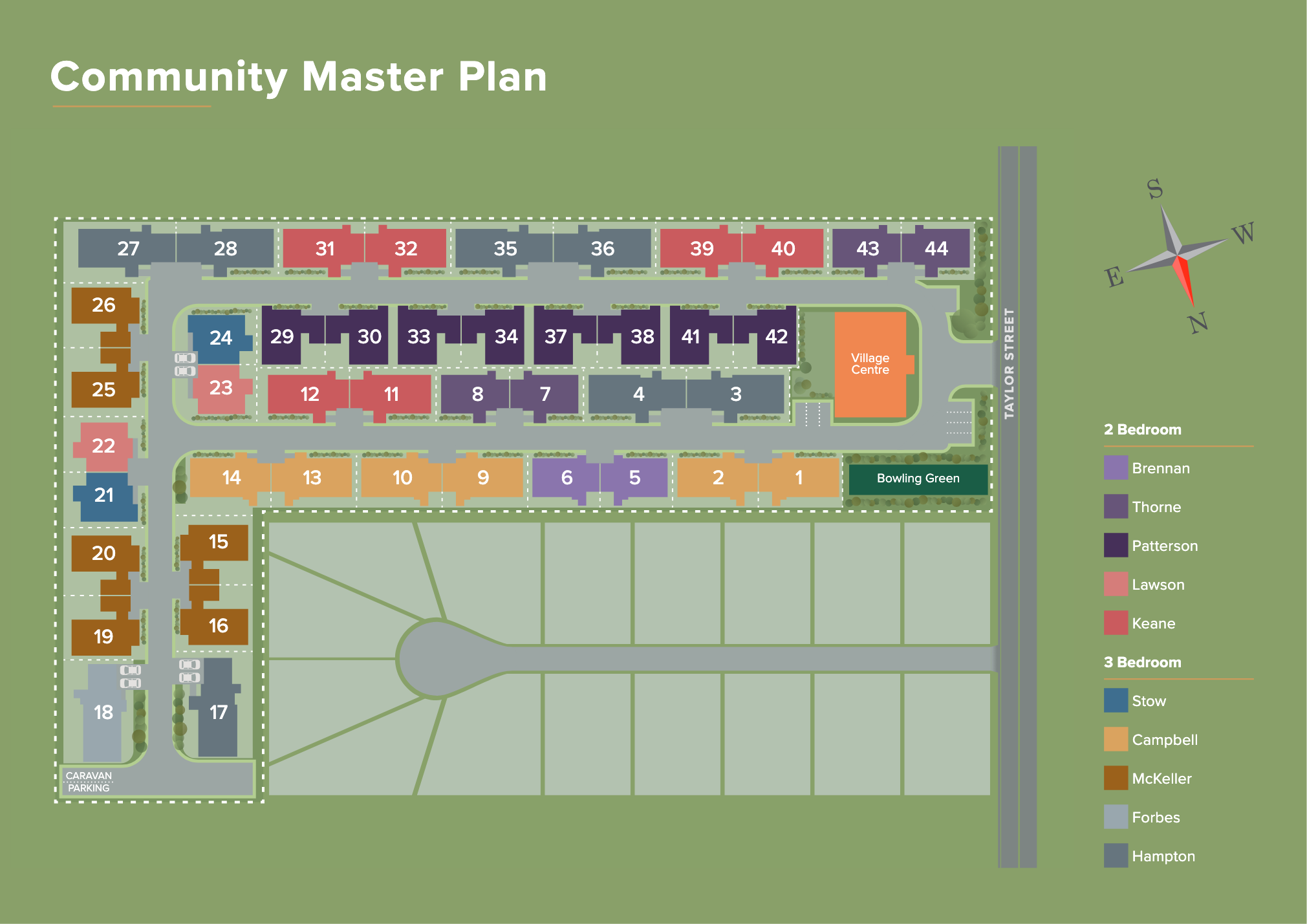
“Use our village map to help you get oriented with what's on offer here at Taylor Street, so you have a feel for the layout, the outlooks, and where the key facilities sit before we step outside.”
“And then, probably most importantly, spend fifteen to twenty minutes walking you through the financials, often the part people find most valuable. I'll cover the three questions I'm most often asked: what does it cost to buy in, what will you pay while you're living here, and what costs are associated with leaving.”
“And finally, we'll walk through the facilities and two or three villas we've identified as a good fit, based on everything you've told me.”
“Does that sound good to you?”
“So, if it's okay with you, I'd like to discuss the financials. Is that okay with you?”
“Wonderful. If I could ask you to hold off on any questions until the end, you'll find that I'll more than likely answer them as we run through the information over the next fifteen to twenty minutes or so.”
“That's a great question, if you let me finish this, I promise I'll get to that in a few minutes. Is that okay?”
“Firstly, at Oak Tree we use a Leasehold Agreement. What this simply means is that you have the right to occupy your villa for up to ninety-nine years, but Oak Tree still owns it, which means there are some significant financial benefits to you, which I'll go into shortly.”
“We're also governed by state legislation under the NSW Retirement Villages Act, which should give you some further peace of mind that there are significant protections in place governing how retirement villages operate.”
“You previously indicated a two-bedroom villa would be suitable, is that correct? Great. So let's look at what it costs to move into the village.”
“Essentially it's similar to buying a residential property, but the biggest difference is that no stamp duty is payable. That will save you somewhere in the vicinity of thirty to forty thousand dollars upfront.”
“The second most common question I am asked is: what will it cost me whilst I am living here? This is what we call a recurrent fee, we call it that simply because it recurs every week.”
“So you don't have to worry about finding a tradesperson, you simply fill in a maintenance request form at reception and the village team takes care of the rest. Most importantly, the cost of the repair is included in your recurrent charge. No little financial surprises.”
“Yes, like most things in life, costs increase over time. But Oak Tree cannot make a cent of profit out of the recurrent charge. It purely covers the cost of running the village.”
“Is that explained clearly?”
“All capital replacement costs. Oak Tree is responsible for the big-ticket items, lifts, gutters, fencing, roofs, pools, driveways. When any item of capital can no longer be repaired, replacing it is Oak Tree's responsibility, not yours.”
“It extends to everything we supply within your villa too, dishwasher, air conditioning, oven, cooktop. And to the refurbishment of your villa when you leave. If you haven't damaged it, it's fair wear and tear for the time you've lived there, and you're not responsible for refurbishing it either.”
“Does that make sense? Great.”
“And finally, the most important question, what happens come the time you leave the village? This is commonly referred to as the Departure Fee.”
“So how does Oak Tree remain financially viable? By way of the departure fee.”
“What our residents love about the Lifestyle Contract is the complete safety, transparency and clarity it gives them and their families, right now. No questions left unanswered.”
“If you decide to move forward with a villa, whether that's after we've toured together or after you've had a chance to speak with family, it starts with a $1,000 initial deposit, and that deposit is fully refundable for up to six months after you move in.”
“One thing worth mentioning, with the new Anti-Money Laundering laws that have come into property transactions, we do have to complete a simple Verification of Identity check. It sounds a lot more complicated than it is, I promise. It's honestly very simple.”
“Once that's done, our solicitors, Minter Ellison, will send through the trust account details so you can transfer the thousand dollar holding deposit. And just so you know, this isn't unique to Oak Tree. Everyone has to do it now. Even when you sell your own home, whoever buys it goes through exactly the same process.”
“I encourage you to. I'd just ask that you make sure you have full clarity by asking these four questions:”
“Does everything I've covered make sense? Have I explained that clearly, and do you have any questions?”
Keep the script flowing first. Bring these in once you've finished, or if they press the point directly.
All 44 villas at Taylor Street. Filter to what they asked for, then two or three go on the walk, the rest stay off the table, or nothing is memorable.
Read this aloud. If any line is wrong, better you find out now than in a week.
“Would you like to go ahead?”
Private to you. Nothing here goes to your manager unless you send it.
Each step owns a slice of the header strip, sized to its minute budget. Navy while you're inside it, tan the moment you're over, the Financial Discussion is the one that always runs long, so it gets four screens and its own share of the strip.
© The Abel Method 2026. No content may be reproduced without the written consent or permission of Alison Abel.
Should the village blanks be set once per village by a manager, or per appointment by the consultant? And does the Money Matters Sheet need to live in here too, or does it stay paper on the table?